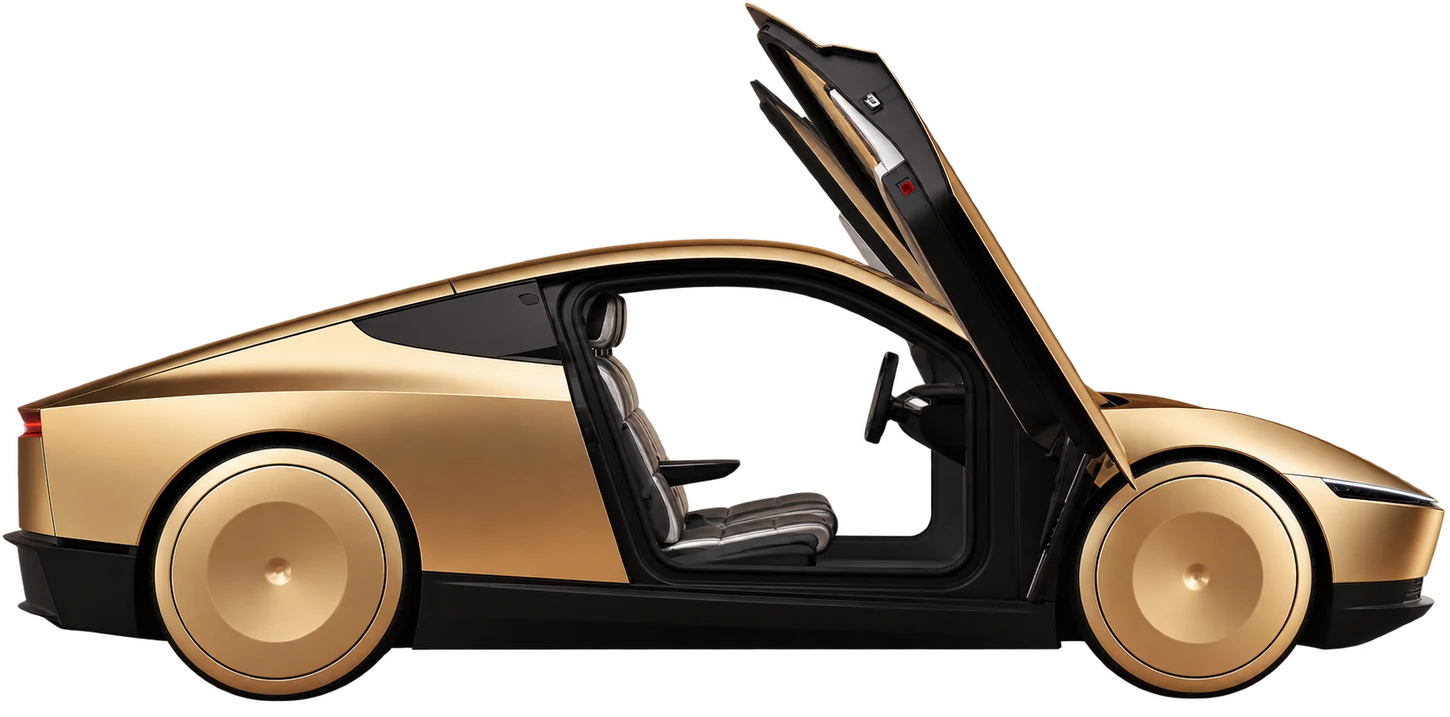

The first meme that
pays the fare.
Hold $CYBERCAB and collect Cyber Miles. Every Ride, a share of the tokenized TSLA the cab has bought lands in the wallets that stayed on board.
Don't stake. Just ride. 🚕
0x88140EF4DE3f622E66880678435DA535D86CD6FB
Specifications
The real Cybercab was revealed with an unusually short parts list. We took that as a design brief and kept going.
Everything above the thick line is a genuine feature of the vehicle shown in Burbank. Everything below it is us.


On board
Every ride pays the fare. The fare buys tokenized TSLA. The TSLA goes in the vault, and at the end of each Ride the vault pays out the passengers who covered the most miles.
Every figure here reads straight from the contract once $CYBERCAB is live. Nothing on this page is a projection.
Under the hood
Five steps, no discretion at any of them. The rules live in the contract, not in a Telegram announcement at 3am.
 You rideBuy $CYBERCAB and hold it. That's the whole action.
 The fareA published share of protocol fees is set aside as the Taxi Fare.
 The vaultThe fare buys tokenized TSLA, which goes into the Cybercab Vault.
 Your milesBalance times time held, counted on-chain while you do nothing.
 The payoutThe Ride closes, the pool splits by miles, the TSLA lands in your wallet.
The fare works both ways
The meter fills the vault. The vault pays the passengers. Your share is decided by one number — how much you held, multiplied by how long you held it.

There is no staking contract to deposit into. Your tokens never leave your wallet, so they were never sitting inside somebody else's code.
No vesting, no cooldown, no exit penalty. You can leave whenever you want — your miles simply stop counting and reset to zero.
No claim button, no gas spent chasing a payout. When a Ride closes, the TSLA is sent to the wallets that held. You are not required to notice.
Both wallets bought the same amount and both finished holding. Only one of them was in the cab the whole way, and miles are the only thing the distribution looks at.
Each Ride closes on a published schedule and its pool splits proportionally to the miles recorded for that season. Amounts move with trading activity, are set by the rules in the contract, and are never fixed, promised or guaranteed. Selling any part of a balance resets that wallet's miles.
Launch
Deployed through Pons on Robinhood Chain. Fixed supply, liquidity locked, everything circulating from the first block. Market cap equals fully diluted value, because there is no second number waiting in a spreadsheet somewhere.
Boarding
Four steps. No licence required, which is convenient, because there is nothing to drive.
Use a self-custody wallet, add Robinhood Chain, fund it with ETH for gas.
You don't need to hold TSLA first. The pool is CYBERCAB/TSLA, but the router hops through it for you, so you can swap in with whatever is already in your wallet.
Paste the address from this page into Pons and read it character by character. Nobody is driving, so nobody will catch your typo.
Miles start at the block you buy. Get out and they go back to zero.

Questions
Nobody. That's the product. At the We, Robot reveal, the Optimus robots pouring drinks turned out to be remotely operated by humans backstage, and Tesla was reportedly paying up to $48 an hour to people willing to be the robot. We have no robots, no operators and no budget, which is how we ended up genuinely autonomous.
No. $CYBERCAB is a meme token. The vault and mile system are community mechanics, not a fund, a yield product or a claim on anything. No return is offered, promised or guaranteed, and holding the token gives you no legal right to the vault contents.
Pons deploys fixed-supply tokens and the whole supply is circulating from the first block. No team allocation, no vesting, no future unlock, so there is no larger number hiding behind the one you can see.
All the liquidity sits in that one pool, and tokenized TSLA is native to Robinhood Chain. You don't have to hold TSLA to buy — the router will route through it for you. It only means every trade eventually passes through that pool, so its depth is what decides your price impact.
A Ride is a season, thirty days long. Through it the Taxi Fare keeps buying tokenized TSLA into the vault, and every wallet keeps racking up miles. When the Ride closes, that season's pool is split between passengers in proportion to the miles they covered, and the next Ride starts counting from zero.
You don't. There is no claim button, no staking deposit and no lock-up. When a Ride closes, the tokenized TSLA is sent to the wallets that held, in the same batch. The only thing you have to do is nothing at all — which, on this website, is the recurring theme.
Selling. Move any part of the balance out and that wallet's miles go back to zero and start again from the block after. Buying more adds to the balance and the miles keep counting on the larger amount. Splitting across several wallets doesn't help either — miles are balance multiplied by time, so two half-sized wallets accrue exactly what one full-sized wallet would.
Nothing on their own. They're a scoring system, not a token, and can't be bought, sold or transferred. They only decide how a Ride's pool is split between eligible wallets. If trading was quiet that season, the pool is small or empty, and a large share of nothing is still nothing.
Yes. The Cybercab drove journalists around a fake city on the Warner Bros. backlot in Burbank, on standing sets used for Westworld. A show about lifelike machines in a constructed town that visitors mistake for the real thing. Nobody involved appeared to notice.
No. No relationship with Tesla, Inc., its executives or the Cybercab vehicle. This is an independent fan parody. Robinhood and Pons are likewise unaffiliated.
Yes, all of it, quickly. Meme tokens have no fundamental value and can go to zero within hours. Only put in what you are willing to lose entirely.